
How Municipal Warrants Work in Texas
Every Texas municipal court is a city trial court. Its docket covers city-ordinance violations plus fine-only Class C offenses under state law, and that includes many local traffic tickets. Warrant power reaches only that Texas court's own docket. A warrant can follow a missed plea. A warrant can also follow a fine judgment that stays unpaid after court process. Labels vary with the case stage. One Texas municipal warrant may be styled an arrest warrant, alias warrant, capias, or capias pro fine, depending on the case stage and local docket wording. Municipal courts sit beside the county's Justice Courts, not beneath them. County-level criminal courts sit alongside them as well. Texas court statistics for FY2024 counted 954 municipal courts across the state. That number is reporting court units, not a warrant total. Every Texas city court keeps its own record. Ask the clerk which payment, appearance, or hearing options apply. A Texas warrant from a city citation does not automatically belong to the county sheriff just because both offices serve the same area. The Texas Judicial Branch describes the municipal tier in its court-structure overview, and the FY2024 Texas Judiciary annual statistical report gives the statewide court-unit count.
Texas City Warrants Stay With the Municipal Court
The clerk of the municipal court is the first stop for any Texas city warrant. The warrant sits in the city's own case system. The clerk can give current status and the next step. Under the Texas Code of Criminal Procedure, Article 45A.103, municipal process may be served by a peace officer or the municipality's marshal. Local police often carry out that process. A marshal may serve it too. The serving agency can hold service details the clerk's public page never shows, so a call to that office can fill gaps. Sheriff lists can miss city cases. A Texas municipal case may not appear in the county sheriff's public warrant search. Texas DPS runs TCIC, but that is a restricted law-enforcement index rather than a public site for checking every city court. Online coverage varies by Texas city and court. A blank sheriff's page settles nothing. An absent entry does not mean no municipal warrant is active, so ask the issuing Texas court directly and give the citation or case number. City process can be served by a municipal police officer or marshal even when the county sheriff does not keep the Texas city docket. The Texas Code of Criminal Procedure, Chapter 45A sets justice- and municipal-court procedure, including municipal service authority.
Municipal vs County Warrants in Texas
Texas city and county warrants differ in three ways. The issuing court and the docket behind the case come first. The record keeper matters just as much. The third is service. City courts take ordinance and Class C fine-only cases. Justice Courts keep a separate fine-only and traffic docket. County-level criminal courts and district courts handle matters within their own Texas jurisdiction, and service splits too: the county sheriff may serve county process, while city police or a municipal marshal can handle municipal service.
| Feature | City Court Warrant | County or Other Criminal Warrant |
|---|---|---|
| Issuing court | Texas municipal court for city ordinance or fine-only state-law cases | Texas Justice, county-level, district, or other authorized court |
| Common case | Texas city citation, ordinance matter, or fine-only Class C offense | Case assigned to the issuing Texas county or district court |
| Record custodian | Texas municipal court clerk and city case system | Texas JP, county, district, or designated court clerk |
| Possible server | Texas municipal marshal, city police, or another authorized peace officer | Texas sheriff, constable, police, DPS, or another authorized officer |
| Online visibility | Texas city page if offered; county sheriff list may not include it | Texas local portal or law-enforcement record; no single public statewide search |
TCIC is not a public search tool. That statewide license-hold lookup is no warrant database. Start from the city and court named on the citation, then use Browse Counties for local Texas court and service-office routes.
Texas City Warrant Terms Have Different Jobs
Alias and capias pro fine are different tools. In Texas, an alias warrant follows a failure to enter a plea or appear after notice. A capias pro fine comes after judgment. It enforces a fine-only obligation once the required court process has run, so it is not a fresh accusation. Check the Texas docket for the exact label. The Dallas Municipal Court warrant-type information page explains local terms and resolution options.
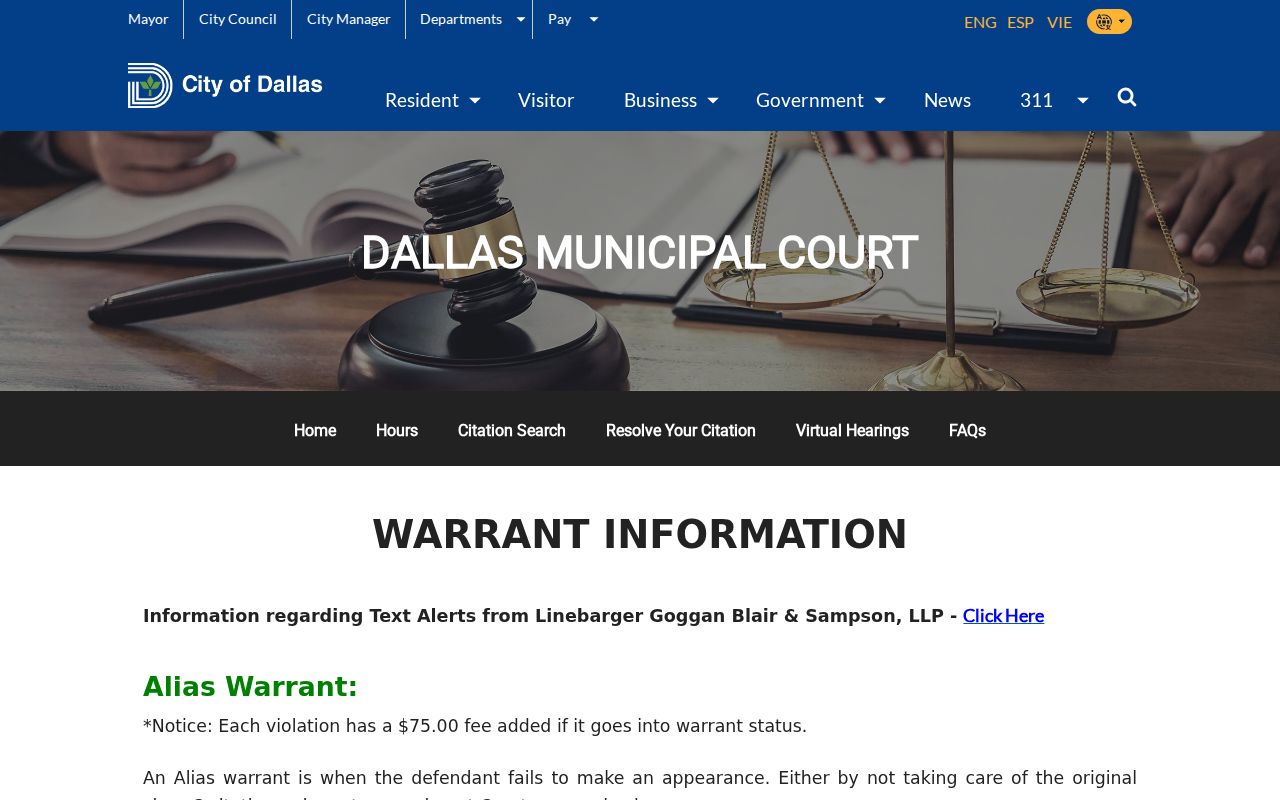
Dallas is one city's example. Other Texas municipal courts, Justice Courts, and county warrants may carry different labels and options.
- Alias warrant
- A later or repeat Texas warrant process after an earlier notice or appearance requirement went unanswered; local use varies.
- Capias
- Texas court process directing that a defendant be arrested and brought before the court.
- Capias pro fine
- Texas process enforcing an already-entered fine-only judgment after the court’s statutory steps.
Note: A municipal court's local definitions and public-list fields do not add up to one Texas-wide warrant schema.
Texas Municipal Warrant Checks
Start with the Texas city printed on the citation or court notice. The warrant belongs to that court. A countywide sheriff search alone may miss a Texas city warrant. Lost the paperwork? Use the municipality and the case details you have, and ask the clerk which search route fits. Texas cities share no single public municipal warrant database, and the fields vary from court to court.
- Identify the Texas city court and citation, docket, or case number tied to the notice or charge.
- Use the Texas city’s official case or warrant page if one is offered, following that page’s exact search instructions.
- If no result appears, call the Texas municipal clerk and ask whether the citation has entered its system, whether a warrant issued, and what status the court shows.
- Ask the clerk which Texas city police or marshal office handles service if that detail affects your next step.
- If the case belongs to a Texas JP or county court instead, use Browse Counties to reach that court and its county sheriff or constable channel.
A blank result on a Texas city portal is not the last word. The court may be running behind on data entry, or the portal may only reach one court's files. Warrant checks through the city site can lag or miss a case. Ask a Texas clerk to look deeper, since a different case number, a payment, or a missed appearance may be what actually triggers the warrant.
Texas Municipal Warrant Searches Use Local Fields
Search forms belong to one city court. Texas has no statewide search schema behind them. Dallas, for one, lets people look up a citation or docket by ticket number, by police case number, by warrant number, by name, date of birth, driver-license number, or vehicle details. Warrant status shows in red there. That interface is one city's design. Other Texas courts may take fewer identifiers or use different labels. The Dallas Municipal Court search instructions lay out the local Texas query choices and when a new citation can be entered.
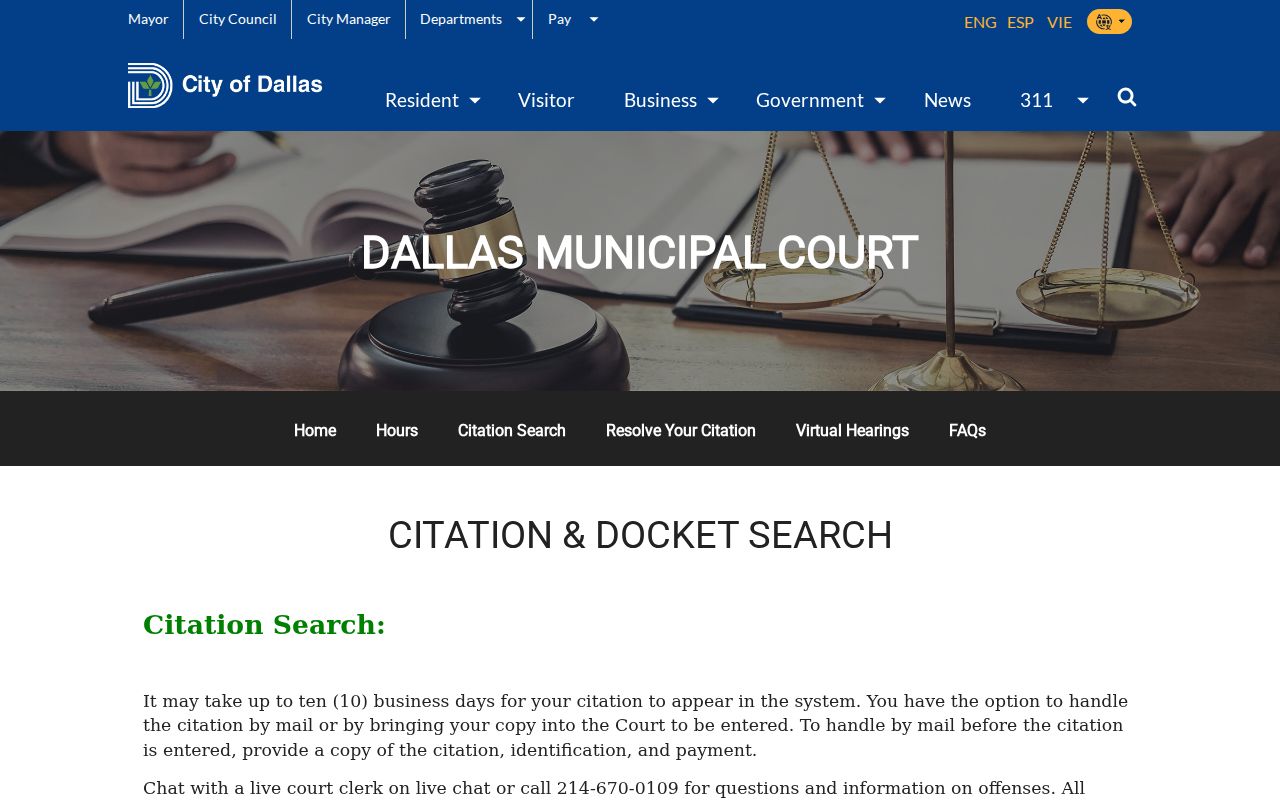
Dallas warns that a new citation can take up to ten business days to show up in its Texas system, and that timing is Dallas-only, not a rule for other courts. A name search that returns a possible match needs a second look. Pull the court's case number and charge details to confirm you have the right person and the right case. A similar name or a red flag on the screen does not settle the legal status by itself. Ask the Texas clerk whether a separate warrant exists, whether the entry is current, and whether a hearing or other court action is required. Note: A city's citation-entry delay is local guidance and does not apply to other Texas court systems.
Municipal Warrants: What They Show
A Texas municipal record can show a citation or case number, the offense charged, the city court handling it, and any warrant or capias status on file. Some local Texas screens also list a dollar amount and the date the entry was last updated. Fields vary from city to city, and the state sets no shared format for municipal warrant numbers. Before trusting a status label, compare the court's page against what the Texas clerk has on record.
| Warrant or case number | Use the exact identifier printed by the Texas city court; municipal courts do not use one universal format. |
|---|---|
| Person and citation | Texas name and the citation, ticket, or docket identifiers that connect the entry to a case. |
| Charge or ordinance | The Texas city ordinance or fine-only state-law offense that the court is handling. |
| Issuing city court | The Texas municipal court responsible for the docket, status, appearance, and resolution instructions. |
| Amount and status | A Texas local balance or warrant category, if the public page displays it; confirm each with the clerk. |
| Update date | A local Texas data date may show when a public view last refreshed, not when a court order was entered. |
College Station publishes metadata for its warrant dataset: name fields, ticket number, offense date, warrant amount, charge description, and a last-updated field. Those columns describe one Texas city's data. The dataset is not a complete warrant list for the court, and its live rows are not a statewide sample of Texas warrants. Note: Texas public metadata identifies fields; it is not a complete statewide warrant index or proof that any person currently has a warrant.
Texas Municipal Warrant Lists Cover One Court
A Texas public city list covers exactly one court's docket. The College Station Municipal Court warrant page holds that city's data and nothing else. DeSoto takes a different cut, splitting arrest-warrant status from capias-pro-fine status and linking its local warrant information; the DeSoto Municipal Court warrant page explains both categories and how each gets resolved. Neither page is a county or statewide roster. A JP precinct, a county criminal court, or another Texas city may keep its own record with its own process, so a warrant check has to hit each issuing court.
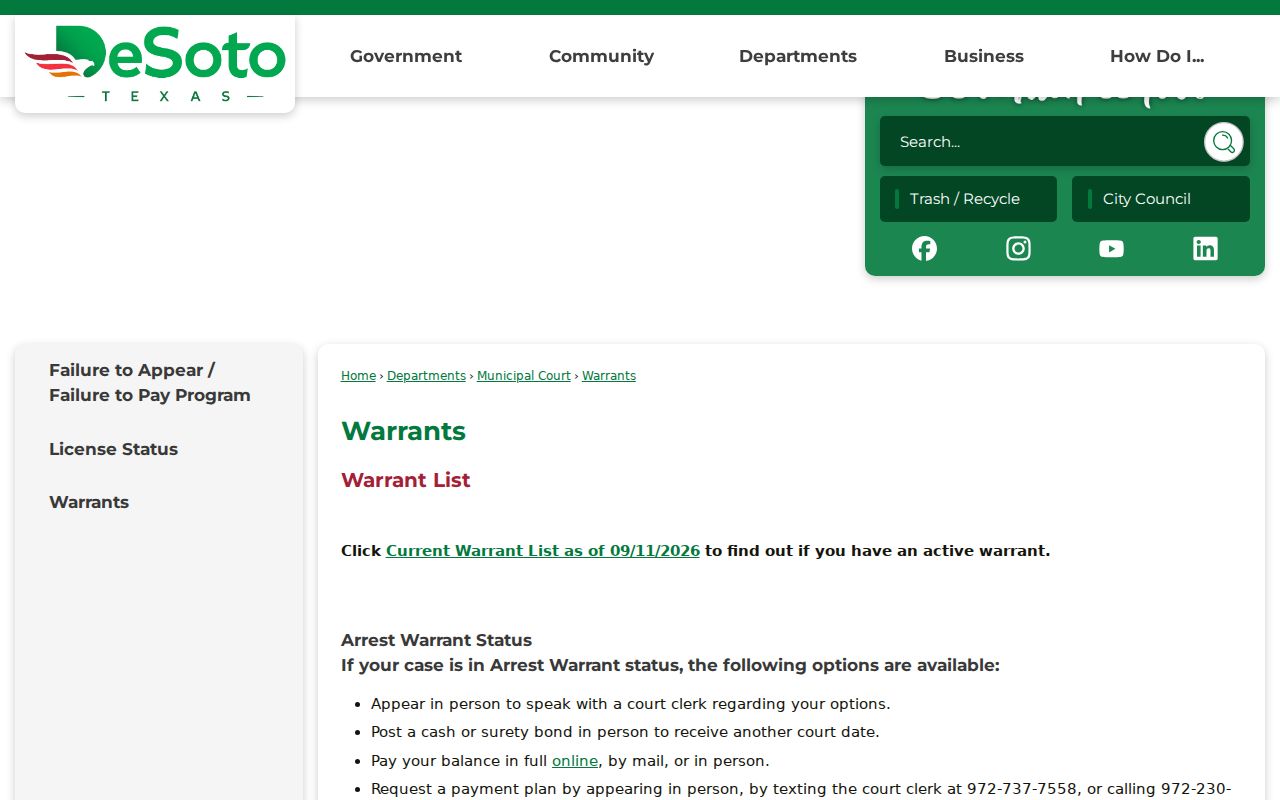
DeSoto's page is a local example, not a DeSoto County or Texas-wide search. Trust only the city court's own explanatory information, and never read a dated list as proof about another court or a different person. Texas counted 954 municipal courts in FY2024, and each is its own reporting unit rather than part of one shared system. The judge's clerks keep their own dockets. The issuing court can confirm whether its warrant entry is still current and whether the city police, marshal, or county agency holding the warrant got notice of a recall.
Clearing a Texas Municipal Warrant
Call the Texas municipal clerk before you drive anywhere, pay anything, or show up in person. Ask whether the warrant is still active and whether the judge wants you in court. Get the exact balance and the accepted payment methods. Ask if a bond would reinstate the case. On a Texas fine-only judgment, ask about an ability-to-pay review, a payment plan, community service, or another approved option. For a Texas FTA warrant, ask about a reset, a recall, a bond, or a new hearing date.
- Confirm the Texas city court, case number, warrant wording, and current status with the clerk.
- Ask whether the Texas matter is an alias or FTA warrant, a capias pro fine, or an FTAP license-hold report.
- Use only the payment or appearance route the Texas court confirms. A payment to DPS or OmniBase does not clear a city-court warrant.
- Ask the Texas court to confirm the recall or clearance in its docket and whether it sent any required update to a serving agency or FTAP.
Caution: Paying a Texas city fine does not always recall a separate arrest warrant; ask the issuing clerk which court action will clear the warrant itself.
A Texas city case runs through the municipal clerk, plus any city marshal or police office assigned to it. Those offices handle the paperwork directly. A JP or county case belongs to a different issuing court, and Browse Counties points you there. Note: The Texas city clerk controls the municipal case; Browse Counties routes elsewhere only when the case belongs to another court.
Chapter 45A Has a Texas City-Warrant Recall Rule
Texas Article 45A.104(g) gives justice and municipal judges a recall duty. The judge must recall a qualifying failure-to-appear arrest warrant when the defendant shows up voluntarily and makes a good-faith effort to resolve the case before the warrant is executed. The rule fits only the Texas statutory FTA process in a justice or municipal court. It does not reach a felony warrant, a family-court capias, or a capias pro fine issued after judgment. Ask the municipal clerk whether your Texas case qualifies and how the court records the voluntary appearance. Recall does not erase the underlying citation. It also guarantees no particular plea, payment plan, or outcome. If the court orders a recall, confirm that the Texas docket was updated and ask whether the serving agency needs separate notice. A city payment portal, a sheriff's search, and FTAP status may each show a different slice of the record. The current Texas Chapter 45A text contains the justice- and municipal-court recall provision.