
How Texas Runs Its Most Wanted List
Texas 10 Most Wanted is run by the Department of Public Safety together with the Governor's Public Safety Office and Texas Crime Stoppers. DPS investigators pair up with local law-enforcement partners. Together they pick fugitives and other listed categories the program treats as serious public-safety threats. Rewards and tips drive the whole design. It was never built as a name-search portal for all Texas warrants, and it does not try to be one. The official Texas 10 Most Wanted program page lists the current categories and points readers to its reporting channels. Cases come off the list as they get resolved. Remember what a listing cannot do. It cannot tell you whether a Texas court has issued or recalled a warrant in a separate matter, and the Texas DPS program page shows only its title and category navigation above the case material.
The view covers only the Texas program header and its navigation, with no person profile or roster entry.
Texas DPS Texas 10 Most Wanted
The official statewide program describes its selected categories and links to current tip instructions.
Texas 10 Most Wanted Reward Rules
Reward money in Texas depends on the program category and designation. Featured fugitives and featured sex offenders can draw a higher reward during their featured month. That is why readers should pull the current official instructions instead of trusting an old notice. DPS says Texas Crime Stoppers rewards come from the Governor's Public Safety Office. The rules spell out which tip channels count and how a tip number gets assigned. A reward rides on the selected case and the tip process, nothing more. It says nothing about how many active Texas warrants exist. It also does not mean every wanted person is in the program, since the statewide list is a small public-safety selection. Local courts and service agencies keep their own warrant records apart from it. Note: A Texas reward notice can change with a designation, so check the live DPS directions for current terms before sending a tip.
Statewide or County Most Wanted in Texas
Texas DPS curates the statewide program, but a Texas county sheriff can publish a separate local wanted page. A city police department or a federal district may post its own notices too. Nothing combines into one roster. Local pages reflect different case types and service priorities, so use a public page only for the purpose its agency states.
| Feature | Texas State Program | Local County Page |
|---|---|---|
| Run by | Texas DPS with state and local partners. | The Texas county sheriff or another local agency. |
| Purpose | Seek tips on selected cases and categories. | Share that agency’s own wanted information. |
| Coverage | A curated set, not all active Texas warrants. | Records and cases within the agency’s stated scope. |
| Where to check | The official DPS program page. | Open the Texas county directory to reach a local sheriff source. |
| Does it confirm a court record? | No. The program is not a docket search. | No. Ask the issuing court about the current case status. |
Need a sheriff's wanted page or an issuing court? Open that county in the Texas county directory. Each county page routes you to local information; none is a complete Texas list.
Texas Fugitive Task Forces Are Not Search Portals
The U.S. Marshals Service coordinates multiagency fugitive task forces with federal, state, and local partners. Texas hosts several. Named examples include the Lone Star Fugitive Task Force in the Western District, the North Texas Fugitive Task Force in the Northern District, and the Gulf Coast Violent Offenders Fugitive Task Force in the Southern District. Their work supports fugitive investigations and warrant service. What they do not run is a public query for every Texas or federal warrant. Task-force territory follows federal district lines and partner-agency deals, not one statewide search boundary. A task force may back a Texas case alongside DPS, a Texas sheriff, a constable, city police, or federal agencies. Even so, the public program pages are institutional information only. For the current status of an individual case, the Texas issuing court remains the source.
U.S. Marshals Fugitive Task Forces
The official service page describes the multiagency task-force model, not a Texas warrant lookup.
Sending a Texas Tip Safely
DPS and Texas Crime Stoppers take tips on Texas 10 Most Wanted cases three ways: the published phone line, the DPS web tip route, and the stated social-media channel. Tips are anonymous, and the program issues a tip number in place of the tipster's name. Reward eligibility hinges on following the current official submission steps. Send a tip to law enforcement. Never confront anyone yourself. Full official details sit on the DPS Texas Crime Stoppers page. If danger is immediate, call 911 instead of waiting for a tip review.
- Use the current Texas DPS or Texas Crime Stoppers channel listed on the official program page. The published phone route is 1-800-252-TIPS (8477).
- Share the location and details that you know. The Texas program says a tip can be anonymous and uses a reference number.
- Keep the tip number and follow the stated steps if you are seeking a reward. Each designation can have its own terms.
- Do not approach, follow, or try to detain anyone. For immediate danger, call 911.
Safety: Send Texas program tips through DPS or Texas Crime Stoppers, keep the reference number, and leave contact or enforcement to law officers.
The DPS fugitive-program interface provides navigation and tip instructions above individual case material.
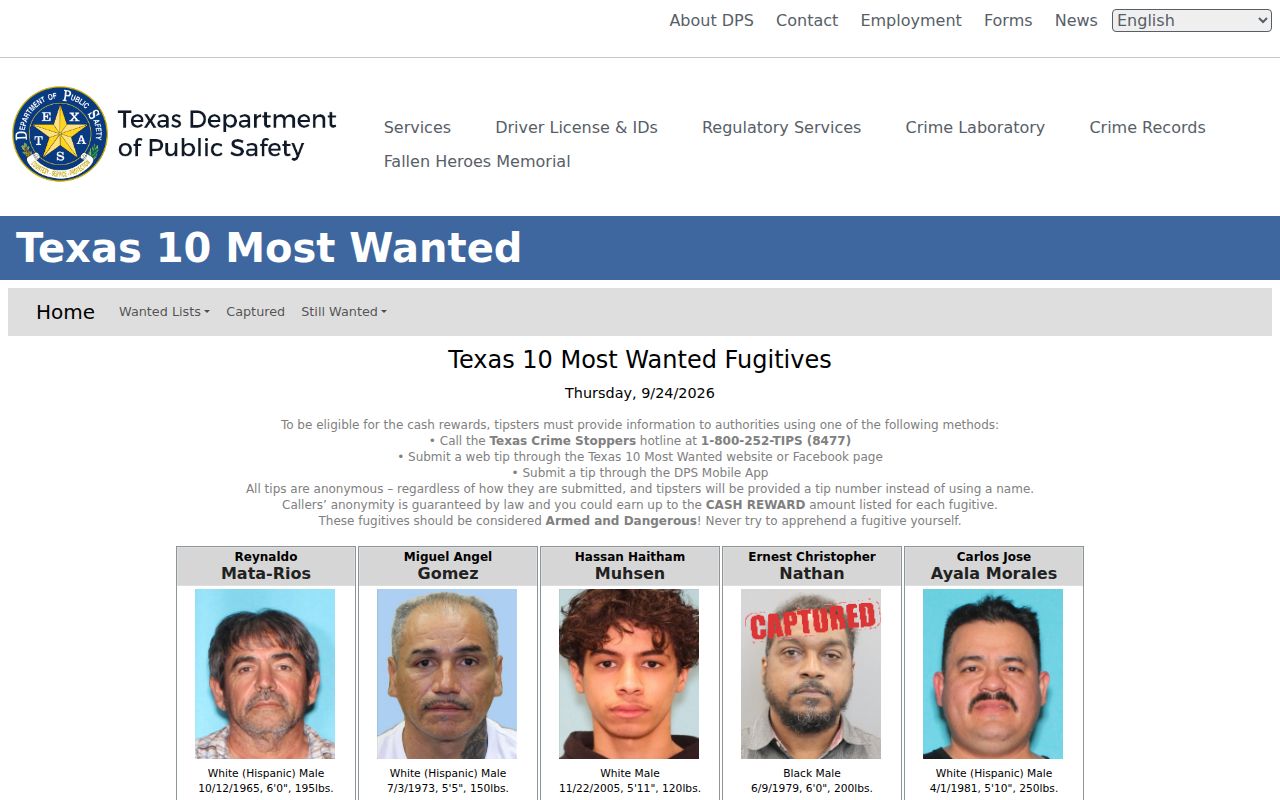
The Texas DPS header and reporting guidance are all that appear here, with no profile or identity detail.
Texas Crime Stoppers
The state program provides a public route for anonymous tips and reward information.
A Texas DPS Tip Page Cannot Confirm a Warrant
The Texas DPS page invites tips on a handful of selected program cases. That is all it does. A listing there is no docket and no name search. Someone left off the page can still have a warrant, and a featured case does not show the other Texas court orders behind it. Texas county courts and sheriffs keep separate files. So your own warrant check starts local. Use the citation, the cause number, or a court notice to pin down the issuing Texas court, then ask the clerk there whether a warrant is still active and which agency serves it. If a Texas service agency has to answer, stick to its official contact path. The Texas county directory is the route to those local records. Note: A tip line sends information about a selected case to law enforcement; it never returns your court status.
Texas Most Wanted or Active Warrant
A Texas most-wanted entry is a tip and reward notice, nothing more. An active warrant is a court order. It can sit on a person who never makes any public list. Texas has no public search of all active warrants. The DPS program is no substitute for a county or court search in Texas. A missing name does not clear a case. Flip it around, and the program page is still not the court record that fixes a warrant's current status. For a specific case, go to the issuing court and the local agency that serves the warrant. The Active Warrant Search page explains how public county lists differ and how to confirm an entry with its issuer. That is the reliable warrant lookup, not the tip list.
Texas 10 Most Wanted categories
The selected DPS program is distinct from the active-warrant records held by Texas courts and local agencies.
Texas Program Totals Are Not Warrant Counts
DPS says its Texas 10 Most Wanted program logged 65 captures during 2025. It paid $41,000 in rewards to 11 anonymous tipsters. Those are program numbers, not warrant counts. They cover one curated Texas program year. They say nothing about how many Texas warrants exist, how many fugitive arrests happened, or how many cases sit in Texas state and local courts. Treat the report as context for the tip program. It cannot tell you whether a particular Texas court has an active warrant. The annual summary reports selected results. It publishes no complete list of every open Texas warrant and no agency-by-agency view of case status. The DPS summary of 2025 program results gives the aggregate capture and reward totals. Read it as program activity. It is not a statewide warrant registry. Note: The 2025 totals count Texas 10 Most Wanted program outcomes only, not statewide warrant or arrest activity.
Federal Texas Warrants Follow Another Route
Federal warrants run on federal court process. The U.S. Marshals Service and federal partners handle most of the service. Texas has four U.S. District Court districts. Each one keeps its own venue and records. A federal warrant will not surface in a Texas county sheriff query or an FTAP license-hold lookup just because the person lives in Texas. PACER opens public federal docket material. It is not a full warrant-status search, though. Some records stay sealed or unavailable until service. A docket entry alone does not prove a warrant was executed. For a federal case in Texas, call federal defense counsel or the court about the case route. The U.S. Marshals district office can give official service-agency information. A task-force site describes enforcement work, not a public search portal.
Finding Your Own Name on a Texas List
Seeing your own name, or a family member's, on a Texas most-wanted list is unsettling. Do not rely on a photo or a similar name. Do not approach a listed person. Never try to manage an encounter on your own. A criminal-defense attorney can confirm the case with the issuing court and map out safe appearance or surrender steps. The tip program and the warrant are separate records. The issuing Texas court confirms the case number, the status, and the required court action. For a local question, find the court or sheriff through the county directory. If it might be federal, use federal counsel. A Texas DPS listing replaces none of that. Texas also has no single statewide warrant-amnesty event or list. Any local Texas resolution window is time-limited and court-specific, so confirm eligibility and current status with the issuing court.
Important: If a Texas warrant may apply to you, consult a criminal-defense attorney and confirm status with the issuing court before arranging a safe appearance.